.svg)

Emirates A380 vs. JFK Air Traffic Control: When Communication Breaks Down on the Ground
(1).jpg)
%20(1).svg)
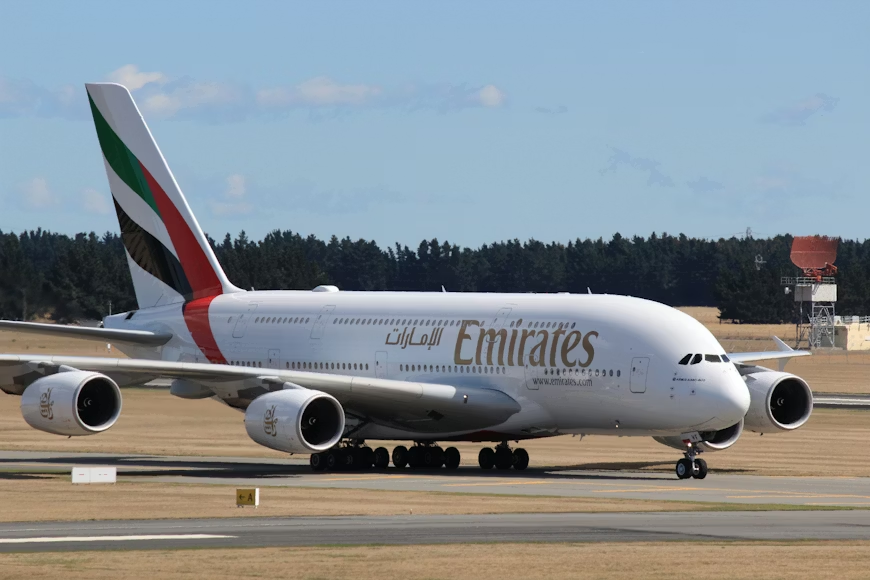
A tense exchange between the flight crew of an Emirates Airbus A380 and air traffic controllers at New York's John F. Kennedy International Airport has recently gotten the attention of aviation enthusiasts. The interaction unfolded while the aircraft was taxiing after landing, a time when miscommunication on the ground can quickly escalate especially at one of the busiest and most complex airports in the world.
While the interchange was never hostile in its tone, it laid bare some deeper issues regarding clarity, pressure of workload, and professionalism in high-stake aviation environments. Let's take a closer look at what happened, why it mattered, and what it says about cockpit-to-tower communications.
The Incident: A Taxi That Didn't Go as Planned
The incident took place on the afternoon of December 9, 2025, just as Emirates flight EK201 landed at JFK from Dubai. As the Airbus A380-a very large plane that demands exacting ground coordination-began to taxi to its gate, the flight crew was given a series of instructions by the tower controller.
Everything initially seemed routine. However, the situation soon turned complex when the pilots notified air traffic control that their gate was still occupied. Thereafter, instructions started to deviate, and confusion ensued.
The controller initially instructed the aircraft to turn onto a certain taxiway and hold short of another. Shortly thereafter, as the aircraft crossed an active runway, the command reversed: Instead of turning, pilots were instructed to go straight ahead and hold short at a different point. This sudden revision of instructions in the midst of taxiing understandably caused confusion in the cockpit.
Confusion Meets Urgency
As the A380 slowed while the pilots tried to confirm their routing, the controller reinforced that traffic was building behind them and the crew needed to keep moving. The word “expedite” entered the conversation-a word that will swiftly raise the stress levels of already unsure pilots.
Eventually, the pilots were instructed to switch from tower frequency to ground control. After acknowledging the handoff, one of the Emirates pilots took the opportunity to address the situation directly. In a calm but firm manner, he stated that the previous instructions had not been clear and suggested that greater professionalism and clarity would have been helpful. That comment did not land well.
A Disagreement That Refused to End
Rather than accept the exchange was over, the controller took exception to the pilot's remark and asked if the instructions really had been unclear. His response was very clear: there were four pilots on the flight deck, one of whom was a native speaker, and none fully grasped the instruction.
It was then that the Emirates crew tried to disengage and effect their frequency change. However, the argument followed them, as once they changed to the ground control frequency, it was clear that the controller had passed a briefing on to a colleague who promptly continued the argument.
What could have ended as a minor operational hiccup instead lingered awkwardly on the airwaves.
Understanding the operational context
To better understand what was going on, it is helpful to know what air traffic control was most likely trying to achieve: with the gate assigned unavailable, the controller seemed to be routing the Emirates A380 along a longer taxi path in order to keep it moving and avoid congestion near the terminal area.
This makes sense from a ground operations perspective: JFK is prone to traffic bottlenecks, and keeping aircraft rolling-even if it means a longer taxi-can prevent gridlock.
However, the problem wasn’t in the plan itself. The problem was how the plan had been communicated.
Long, uninterrupted taxi instructions through large parts of an airport are very unusual; crews might not be familiar in great detail with each and every taxiway configuration. When such instructions change suddenly-especially when crossing a runway-confusion is almost guaranteed to occur.
Where Things Went Wrong
Several factors contributed to the breakdown:
- Lack of clear framing: The pilots were not told upfront that they would be routed all the way around the airport.
- Mid-movement changes: Changing instructions while the aircraft was already in motion increased workload and uncertainty.
- Pressure to hurry: Telling a confused flight crew to expedite can compromise situational awareness.
- Defensiveness: Once the pilot raised concerns, the focus shifted from resolution to proving who was "right."
In aviation, clarity means safety. It is often safer to slow down and clarify rather than to move quickly and misunderstand the instructions.
A Broader Issue at Busy Airports
JFK is notorious among pilots for difficult ground operations and sometimes gruff communication. The controllers there handle high volumes daily under considerable pressure to maintain traffic flow.
That said, pilots flying international routes may visit JFK infrequently. That which is intuitive to a controller who works the same airspace day in and day out may be far from obvious to a crew arriving after having flown 14 hours from the other side of the world.
Effective communication requires acknowledging that difference in perspective.
Professionalism goes two ways
It is worth noting that neither side in this confrontation handled the situation perfectly. While the pilot's feedback was candid, it was not impolite. At the same time, calling out professionalism over an open frequency, particularly at a busy airport, was all but certain to provoke defensiveness.
Still, there had been no need for all of the ensuing back-and-forth. Aviation communication works best when focused strictly on moving forward safely, not revisiting past misunderstandings.
De-escalation is a skill, and this exchange showed how quickly things can spiral when it’s missing.
Why This Moment Resonated
The interaction gained attention not because it was severe-it wasn't-but because it was very relatable: many pilots and controllers have found themselves in just such moments where fatigue and pressure combine with assumptions.
It also served as a reminder that even in a highly regulated, procedural environment like aviation, human factors certainly play a major role.
A little contextual information, even just a single sentence, like, “We’re going to route you all the way around the field because of congestion at the gates ,” would have avoided this entire exchange.
The Bigger Lesson for Aviation
This incident underlines a number of enduring truths about aviation operations:
- Clear, proactive communication reduces workload for all
- Better to slow down and clarify than to hurry through and confuse.
- Ego has no place on an operational frequency.
- Mutual respect between pilots and controllers should prevail.
- Even the busiest airports run effortlessly when those principles are followed.
Final Thoughts
The exchange between Emirates' A380 crew and JFK air traffic control illustrated how small gaps in communication can escalate into unnecessary conflict. Pilots sought to make sense of the rapidly changing instructions; the controllers were at pains to maintain the traffic flow.
In the end, no safety was compromised, but professionalism and patience were tested.
Aviation goes most smoothly when clarity, humility, and cooperation come first
From the cockpit to the control tower, the mission is the same-to move aircraft safely and efficiently. Everything else should come second.
DISCOVER THE RIGHT CARD FOR YOU.
Explore our card recommendations and find a credit card that suits your personal needs.
Browse card categories
%20(1).jpg)
.svg)