.svg)

Etihad Is Making a Major Bet on China Five New Routes in One Announcement
2.jpg)
%20(1).svg)
Almost every international route launched gets a press release. But rarely does a carrier launch five international routes simultaneously in the same country, especially if said launches are announced just a few days apart. This is exactly what Etihad did recently, dubbing its ambitious China market expansion "one of the largest market developments" in the history of the airline.
Etihad Airways will embark on one of the most drastic expansions of its network in mainland China in the coming months, transitioning from offering one destination, operated with seven flights per week, to operating six destinations and 35 weekly flights in just six months. It'll use a concentrated, counter-industry high-volume network model, raising some eyebrows in the process and creating some interesting talking points.
The Schedule of Full-scale Expansion From One To Six Routes in Mainland China
Etihad Airways operates just one route in mainland China at present, serving Abu Dhabi International Airport (AUH) and Beijing Daxing Airport (PKX), with seven weekly flights being the total capacity of Etihad's current China network. Here's what the expansion into six destinations will look like:
- October 1, 2026: Shanghai Pudong (PVG): 7x weekly
- March 4, 2027: Guangzhou Baiyun (CAN): 7x weekly
- March 4, 2027: Hangzhou Xishuangbangu (HGH): 5x weekly
- March 5, 2027: Chengdu Tianfu (TFU): 4x weekly
- March 7, 2027: Shenzhen Bao'an (SZX): 5x weekly
It's a tremendous expansion, increasing Etihad's mainland China capacity by five times, with 7x weekly becoming 35x weekly. The new services will be operated with Boeing 787-9 Dreamliner featuring 28 business-class and 262 economy-class seats. Keep in mind that these services are not including Etihad's existing operations to Hong Kong and Taipei.
Multiple Factors Behind the Expansion
When one carrier expands its route network from just one destination to six destinations, a question needs answering why?
To begin with, there was a relatively recent update of the bilateral air services agreement between the United Arab Emirates and China, granting Etihad access to the necessary number of weekly flight slots in order to launch this network.
In addition to that, there is an existing joint venture between Etihad and China Eastern Airlines, and according to Etihad CEO Antonoaldo Neves, it is "an integral component in our development plans for mainland China." China Eastern already offers flights between Abu Dhabi and three mainland Chinese cities Shanghai, Kunming, and Xi'an allowing for a coordinated operation through the joint venture.
Finally, this strategic move comes from Etihad's belief that "China is going to be a key pillar of our network growth," and it believes that this expansion is "part of our long-term plan to become a key player in one of the world's most economically significant air corridors."
The Competitive Edge: Etihad as the Default Gulf Carrier in China
But there is an even more important strategic reason behind Etihad's China expansion. Namely, Etihad competes with both Emirates and Qatar Airways in just about every international route it offers. These carriers offer larger networks, better recognized brands, and premium passenger bases, which gives them an edge on most international routes.
Not so in China. Etihad may be able to leverage this situation, getting ahead of Emirates and Qatar by expanding its network in mainland China aggressively to five destinations simultaneously. And while Qatar is working on a joint venture agreement in mainland China, the Etihad-China Eastern partnership is likely giving Etihad an edge.
As a result of all of this, if the strategy works as expected, Etihad might become a default Gulf carrier in China, putting its two main rivals in a tricky spot in terms of competing against it in the region.
Counter-intuitive Timing and Risks Involved
But here's the thing Etihad's expansion into mainland China contradicts some prevailing market trends. First, it's important to note that while other markets recovered after the pandemic, demand for international flights to and from China has not yet fully returned to pre-COVID levels. Second, Chinese airlines have been slow to restore their international flights, with low yields for many of those flights remaining a persistent issue for non-Chinese carriers.
Etihad, however, seems to believe in the future of the Chinese travel market, deciding to build up its network in anticipation of a return of travel demand, relying on its joint venture to mitigate the risk of poor yield performance and capitalizing on the early mover advantage in this regard.
And yet, it's important to mention that many of Etihad's latest expansion projects relied on the arrival of Airbus A321LR narrowbody aircraft. Such planes can connect Abu Dhabi to nearby destinations, but are not suitable for China services because of their short range. So Etihad is actually allocating some of its precious widebody slots for a China market expansion.
The Importance of Being Abu Dhabi as a Hub
There's a fundamental principle behind Etihad's ambitious China expansion strategy that Abu Dhabi must become the global hub between East Asia and other destinations around the world.
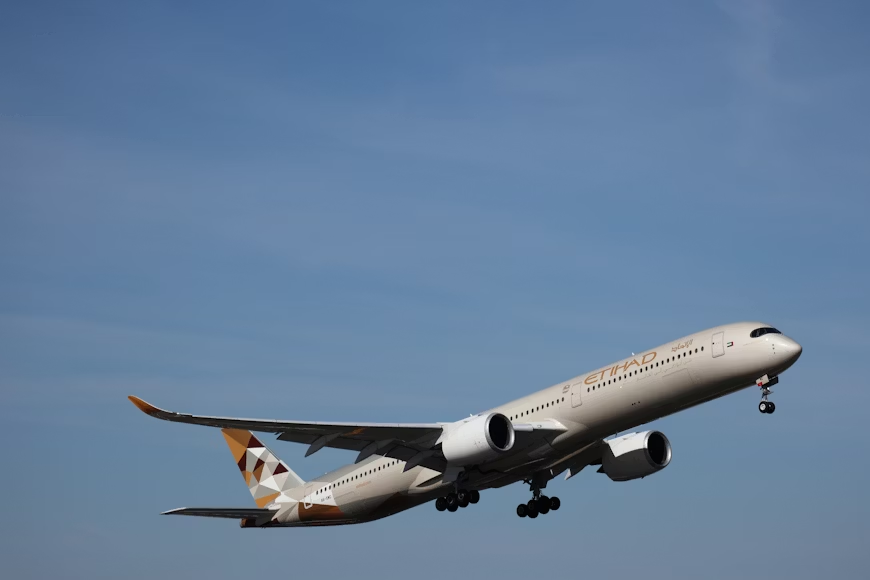
And by adding six China destinations, Etihad will essentially add dozens of new connecting opportunities. For example, passengers traveling from Chengdu to Lagos and Shenzhen to Milan would now be able to take advantage of Etihad's services, making a convenient transfer through Abu Dhabi on the way.
This principle explains why Etihad decided to expand in this specific market, rather than focusing on any other.
Conclusion:
Etihad's China expansion strategy might just prove to be the most ambitious market development project for any Gulf carrier in the past few years. It merits special recognition for its courage in entering a challenging market so aggressively.
While transitioning from just one to six destinations in mainland China within only six months, Etihad has made an impressive move. At a time when many other international carriers remain rather cautious about developing their China presence, Etihad has decided to differentiate itself dramatically.
All of that leaves only the outcome of the project to question success or failure? Ultimately, whether this project will be successful or not depends on a series of unpredictable factors outside Etihad's immediate influence, among them travel recovery in China, future oil prices, geopolitical stability in regions served by Etihad, and viability of connecting itineraries from China to destinations all over the world. If all of that falls into place, Etihad is in for a win.
DISCOVER THE RIGHT CARD FOR YOU.
Explore our card recommendations and find a credit card that suits your personal needs.
Browse card categories
%20(1).jpg)
.svg)